

The United Nations Decade of Ocean Science for Sustainable Development
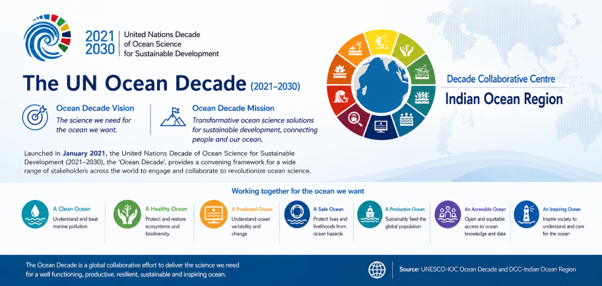
Launched in January 2021, the United Nations Decade of Ocean Science for Sustainable Development (2021-2030)- commonly known as the Ocean Decade-provides a global framework to mobilize ocean science in support of sustainable development.
The Ocean Decade brings together governments, scientists, policymakers, industry, civil society, educators, youth, and coastal communities to work beyond traditional boundaries and drive transformative ocean science solutions. Its aim is nothing less than a revolution in how ocean science is generated, shared, and applied for the benefit of humanity and the planet.
Why the Ocean Decade Matters
- Throughout the Ocean Decade, partners across the world are working collectively to:
- Generate robust data, information, and knowledge to address critical ocean challenges
- Strengthen science-policy interfaces at global, regional, national, and local levels
- Align research, investments, and initiatives around shared priorities
- Support evidence-based decision-making for ocean sustainability
Ocean Decade Vision: 'The science we need for the ocean we want.'
Ocean Decade Mission: 'Transformative ocean science solutions for sustainable development, connecting people and our ocean.'
A Global Convening Framework
The Ocean Decade serves as a neutral and inclusive platform that enables collaboration across sectors and disciplines.
It empowers diverse stakeholders to co-design and implement Decade Actions that contribute directly to sustainable development, climate resilience, biodiversity conservation, and improved human-ocean relationships.
More on the Ocean Decade: https://oceandecade.org/
Decade Collaborative Centres (DCCs)
Role of Decade Collaborative Centres and Coordination Offices
Decade Collaborative Centres (DCCs) and Decade Coordination Offices (DCOs) provide dedicated, long-term support to coordinate and strengthen Decade Actions at:
- Regional levels (e.g., major ocean basins such as the Indian Ocean), and
- Thematic levels (aligned with the Ocean Decade Challenges).
These centres play a critical role in ensuring the effective delivery and impact of Ocean Decade initiatives by supporting:
- Capacity development and knowledge sharing
- Communication and outreach to diverse stakeholder communities
- Tracking and reporting of progress of endorsed Decade Actions
- Resource mobilisation and alignment of investments
- Catalysing new partnerships and initiatives across sectors and regions
Through these functions, DCCs and DCOs enhance collaboration, promote co-design and uptake of ocean science, and optimize the use of resources among governments, scientific institutions, industry, civil society, and communities contributing to the Ocean Decade.
DCC-IOR: Indian Ocean Region
The Indian National Centre for Ocean Information Services (INCOIS), under the Ministry of Earth Sciences (MoES), Government of India, is endorsed as the Decadal Collaborative Centre for the Indian Ocean Region (DCC-IOR) under the UN Decade of Ocean Science for Sustainable Development.
As the DCC for the Indian Ocean Region, INCOIS facilitates coordination, collaboration, and visibility of Ocean Decade Actions across the region, ensuring alignment with Ocean Decade goals and strengthening regional contributions to global ocean sustainability.
The Indian Ocean Region (IOR) is home to over one-fifth of the worldâs population, extending from the east coast of Africa to the western coast of Australia, and from the southern continental margins of Asia to Antarctic waters. The region supports some of the worldâs most productive and diverse marine ecosystems and underpins livelihoods, food security, trade, and climate regulation for millions of people.
Despite its global significance, marine spatial planning is implemented by only a limited number of countries, and large areas of the Indian Ocean remain poorly charted beyond national Exclusive Economic Zones (EEZs). These gaps present both challenges and opportunities for advancing ocean science, governance, and sustainable development in the region.
The Decade Collaborative Centre for the Indian Ocean Region (DCC-IOR) has a regional mandate covering the entire Indian Ocean basin. It delivers the resources, skills, and scientific expertise needed to work with a highly diverse international community, enabling stakeholders to implement endorsed Decade Actions, co-design new initiatives, and catalyse transformative change to address regional ocean challenges.
DCC-IOR supports and contributes to all ten Ocean Decade Challenges in the Indian Ocean Region, with particular focus on the regionâs priority challenges:
Challenge 3: Sustainably feed the global population
Challenge 6: Increase community resilience to ocean hazards
Challenge 7: Expand the global ocean observing system
Challenge 9: Skills, knowledge, and technology for all
Through coordinated action, partnership building, and capacity development, DCC-IOR strengthens regional contributions to the Ocean Decade and supports the delivery of a safe, resilient, productive, and sustainable Indian Ocean.
Team Members

Dr. T. V. S. Uday Bhaskar (Uday)
Scientist, Indian National Centre for Ocean Information Services (INCOIS)
Designated Coordinator - DCC-IOR
Dr. Uday Bhaskar serves as the
Designated Coordinator of the Decade Collaborative Centre for the Indian Ocean Region (DCC-IOR).
At INCOIS, he heads two key divisions:
Ocean Data Management (ODM) and
Programme Planning, Coordination and Capacity Development (PPC).
He is also the Head of ITCOocean (a UNESCO Category 2 Centre)
and the INCOIS focal point for IODE activities, including the
OceanTeacher Global Academy (OTGA) and
Argo programmes. His work focuses on strengthening
ocean data systems, capacity development, and international
coordination in support of Ocean Decade objectives.
Mr. Nagaraja Kumar (Nagaraja)
Scientist, Indian National Centre for Ocean Information Services (INCOIS)
Mr. Nagaraja Kumar is a Scientist at INCOIS and heads the
Operational Ocean Services (OOS) division, which forms the
operational backbone of INCOIS due to its end-to-end delivery of
ocean advisory and information services.
He serves as the Secretary of the Indian Ocean Global Ocean
Observing System (IOGOOS) and manages
INCOIS's international interface, supporting regional and
global collaboration in ocean observing systems and operational
services aligned with the Ocean Decade.
Governing Board
| S.No | Name | Role |
|---|---|---|
| 1 | Dr. M. Ravichandran, Secretary, Ministry of Earth Sciences (MoES), India | Chairman |
| 2 | Director, Indian National Centre for Ocean Information Services (INCOIS), India | Co-Chair Member |
| 3 | Dr. Sophie Seeyave, Plymouth Marine Laboratory (PML) & CEO, Partnership for Observing the Oceans (POGO), UK | Member |
| 4 | Dr. Shubha Sathyendranath, Plymouth Marine Laboratory (PML) & Chair, International Ocean Colour Coordinating Group (IOCCG), UK | Member |
| 5 | Enrique Alvarez, Head, OceanPredict Decade Collaborative Centre, France | Member |
| 6 | Prof. Dr. Nadia Pinardi, Head, Coastal Resilience-DCC, Italy | Member |
| 7 | Heather Koldewey, Lead, Bertarelli Foundation, UK | Member |
| 8 | Maeve Nightingale, Senior Programme Officer Coastal and Marine, Asia, IUCN Secretariat | Member |
| 9 | Fehmi Dilmahamod, GEOMAR Helmholtz Centre for Ocean Research Kiel, Germany | Member |
| 10 | Danielle Su, DHI Water & Environment, Singapore | Member |
| 11 | Juliet Hermes, South African Environmental Observation Network (WCRP) | Member |
| 12 | Jenny Huggett, Department of Environmental Affairs, South Africa | Member |
| 13 | Nick D'Adamo, Representative, Indian Ocean Observing System, Australia | Member |
| 14 | Prof. Dwikorita Karnawati, Head of Indonesia Agency for Meteorology, Climatology and Geophysics (BMKG) | Member |
| 15 | Mohammed Rezah Badal, Director-General, Prime Minister's Office, Mauritius | Member |
| 16 | Michelle Heupel, Director, Integrated Marine Observing System (IMOS), Australia | Member |
| 17 | Ocean Decade Network Manager, Intergovernmental Oceanographic Commission (IOC-UNESCO), Paris | Observer |
Host-INCOIS
Established in 1999, the Indian National Centre for Ocean Information Services (INCOIS) is an autonomous institution under the Ministry of Earth Sciences (MoES), Government of India. INCOIS is mandated to provide reliable, timely, and high-quality ocean information and advisory services to society, industry, government agencies, and the scientific community through sustained ocean observations and continuous advancement via systematic, focused research.
INCOIS has a strong international presence and leadership role in global ocean science and services. It is a permanent member of the Indian delegation to the Intergovernmental Oceanographic Commission (IOC) of UNESCO, a founding member of the Indian Ocean Global Ocean Observing System (IOGOOS), and a member of the Partnership for Observing the Oceans (POGO)âactively contributing to capacity development and international exchange of students and researchers.
INCOIS hosts several major international and regional programmes and secretariats, including:
- IOGOOS Secretariat
- Sustained Indian Ocean Biogeochemistry and Ecosystem Research (SIBER) - International Programme Office
- Second International Indian Ocean Expedition (IIOE-2) - Project Office
Through the Regional Integrated Multi-Hazard Early Warning System for Africa and Asia (RIMES), INCOIS provides operational ocean information and forecasts to member countries, strengthening regional resilience to ocean-related hazards. INCOIS is also a member of the Global Ocean Data Assimilation Experiment (GODAE) OceanView Science Team (GOVST) and its Patrons Group, contributing to global ocean forecasting and data assimilation efforts.
With its strong scientific mandate, operational services, international partnerships, and leadership in ocean observing systems, INCOIS is a natural and well-positioned host for the Decade Collaborative Centre for the Indian Ocean Region (DCC-IOR).
INCOIS Official Website: https://incois.gov.in/
India NDC (National Decade Coordination)
The Ministry of Earth Sciences (MoES) has taken a proactive role in advancing the UN Decade of Ocean Science for Sustainable Development by constituting the National Decade Coordination Committee (NDCC). The NDCC brings together national institutions and diverse stakeholders to coordinate existing initiatives and to co-develop new programmes at the national level, aligned with the objectives and goals of the Ocean Decade. This coordinated approach also enhances national access to Ocean Decade benefits, including capacity development, partnerships, and scienceâpolicy integration.
India's Ocean Decade
The national kick-off of the Ocean Decade in India was held on 3 February 2021, coinciding with the INCOIS Foundation Day at the Indian National Centre for Ocean Information Services (INCOIS). The event was preceded by the Foundation Day lecture delivered by Vladimir Ryabinin, then Executive Director of the Intergovernmental Oceanographic Commission (IOC) of UNESCO, who provided a comprehensive overview of the Ocean Decadeâits vision, objectives, goals, and implementation pathways.
Role of the India NDC
Through the NDCC, India facilitates:- National coordination of Ocean Decade-related activities
- Development of new Decade-aligned programmes and partnerships
- Strengthened science-policy interfaces
- Enhanced participation of Indian institutions and stakeholders in global Decade Actions
India National Decade Coordination Committee (NDCC): https://incois.gov.in/IIW/NDCC/index.jsp